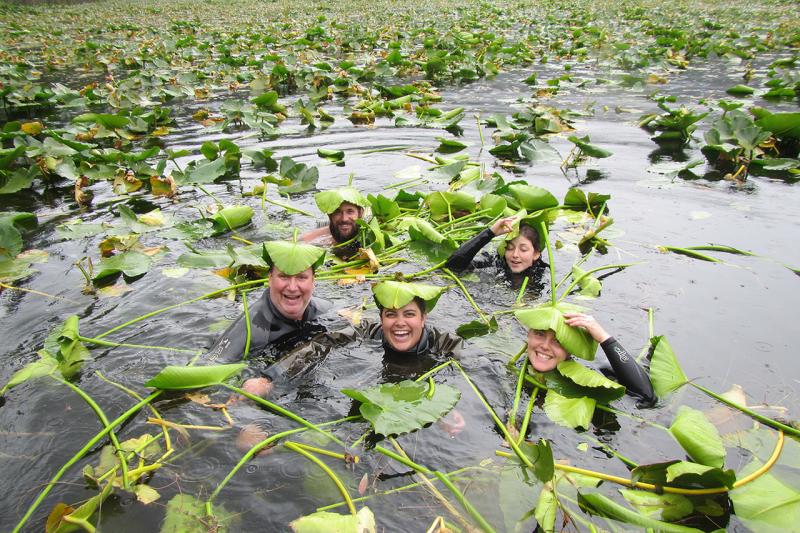
NOAA veteran and conservation corps efforts are creating a community of habitat restoration practitioners across the nation made up of veterans, young adults, and others. The programs are boosting coastal communities by recruiting, training, mentoring, and employing workers to implement habitat restoration projects in support of long-term coastal restoration. There are several unique regional efforts that are a reflection of the wide range of habitats and species we work to protect, conserve, and restore.

GulfCorps participants spend time in the classroom learning about habitat restoration and leadership skills.
On the Gulf Coast, the GulfCorps program, funded by the RESTORE Act and in partnership with The Nature Conservancy, and local organizations in each of the Gulf states, is helping NOAA to restore degraded coastal habitats there. Alabama, Florida, Louisiana, Mississippi and Texas are all benefiting from restoration crews of young adults from local communities. GulfCorps participants are trained to restore coastal habitats like wetlands, oyster reefs, rivers and streams, all while gaining job skills that will help with academic or career goals.

A Veteran Corps Fisheries Program member from California's Los Padres Center uses GPS at a restoration site in the field.
Our other efforts, happening on the West Coast, are focused on training uniformed service veterans in habitat restoration and restoration effectiveness monitoring.
Since 2012, the Veterans Corps Fisheries Program in California has been providing post-9/11 veterans with opportunities to train in fisheries habitat restoration up and down the state. Six corps locations provide vets with a variety of coastal and marine ecosystems to work in, with restoration experts from more than 15 state, federal and non-profit partners. Veterans are helping restore habitat for threatened and endangered species like salmon and steelhead, in places like the Eel River in northern California, and the Ventura River in the south.

Veteran Barney Boyer and mentors from the Mukilteo Science Lab monitor sediment and vegetation in Washington's Snohomish Estuary.
In Washington, in partnership with the Washington Department of Veterans Affairs, veterans are employed and trained in habitat restoration internships. Participants gain valuable skills through an individualized applied science experience helping us evaluate the success of NOAA’s restoration efforts in the Pacific Northwest. In collaboration with NOAA staff and other outside academic institutions, veterans are monitoring restoration projects in the field, analyzing data and authoring reports that contribute to the scientific community. During and after the six-month experience, interns become a part of a statewide network valuable for leveraging next steps in their careers.

In Oregon, our veteran interns are involved in habitat restoration project management, environmental compliance, education and outreach, and GIS and data mapping. They also participate in exciting field work, including collecting water surface elevation and temperature, identifying native plants, controlling erosion, working with restoration contractors, photo monitoring, and processing data loggers.
In Alaska, previous veteran interns have been involved with supporting habitat restoration and natural resource management projects across the state. They have worked with a variety of tribal, nonprofit, state, and federal agencies to better understand the interconnectedness of habitat restoration work. They have recorded data on endangered beluga whales, supported culvert replacement and fish abundance surveys, as well as collected vital water quality data.
NOAA works closely with Mt. Adams Institute to support the work and achievements of these outstanding veterans.
Our veteran and conservation corps initiatives are aligned with NOAA Fisheries’ commitment to partnering with organizations and efforts enhancing ecosystem, community, and economic resiliency around the country. These efforts will help sustain valuable fisheries habitat, and provide participants with employable skills to support long-term coastal economies and restoration right where they live.


