Developing Viable On-Demand Gear Systems
On-demand gear development continues to evolve with the help of industry.
Image
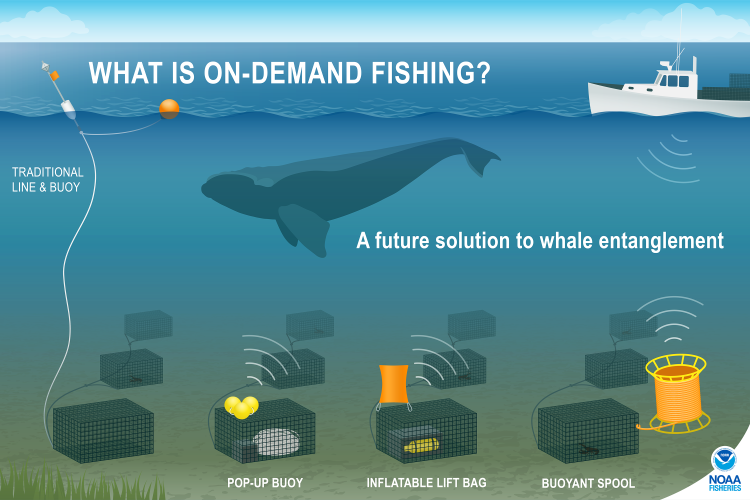
On-demand, also called “ropeless”, systems use far less rope in the water than traditional gear designs. To locate and haul (retrieve) gear, traditional methods tether gear to a rope attached to a buoy at the water’s surface. The main characteristic of on-demand gear is that it does not need this gear-to-buoy tether.
Buoy and Line Alternatives
Pop-up Buoy
The vertical line is coiled in a cage that is on the ocean bottom attached to a string of traps. When a signal is received from the boat at the surface, the buoy or cage top is released from the cage. The line uncoils to the surface, allowing the fishing vessel to retrieve the gear.
Inflatable Lift Bag
A deflated lift bag is attached to a cage connected to a string of lobster traps. When a signal is sent from the boat, the lift bag inflates and the cage rises to the surface. This allows the fisherman to retrieve the cage and the pots that are connected to it.
Buoyant Spool
Line wrapped around a buoyant spool is tethered to a weight on the bottom. When a signal is sent from the boat, the spool is released. As the spool ascends to the surface, the line unwinds from the spool. It rises to the surface where the fishing vessel can retrieve it, and the gear on the string.
The Gear Library
We are helping fishermen test alternatives to the buoy and line, including pop-up buoys, inflatable lift bags, and buoyant spools. To increase systems testing, we have assisted in creating a “gear library.” With the help and donations from environmental and academic organizations, we house dozens of on-demand systems from many different manufacturers.
Permitted fishermen and researchers can borrow from the library to test gear in real fishing situations. In return, the borrowers provide us with insights into how the gear operates on their vessel, any problems encountered, and suggestions for improving the technologies.
Finding and Retrieving On-Demand Gear
If on-demand gear is to be widely used in areas seasonally closed to fishing with static vertical lines, then we need an effective and affordable system for locating the gear. Currently, others in the area can see the surface buoys that are attached to a vertical line connected to the gear on the ocean bottom. With on-demand gear, there will need to be another way.
We’re working with our partners to develop a system that will allow all fishermen operating around a set of on-demand gear—which will not have surface buoys—to know it is there and avoid it. One of many efforts to address this is a recently conducted global technology search with NASA’s Center of Excellence for Collaborative Innovation and Yet2. They are working to identify technologies that may be able to solve these challenges. The Yet2 report on their search concluded that:
- Acoustic technology remains the most viable solution for underwater gear marking
- There are a wide range of global manufacturers with the expertise to meet this demand
- There is reason to believe that the cost of this technology can come down as it finds wider use, such as in on-demand gear marking
Learn more about our field work to test ways of locating on-demand gear
Learn more about the EarthRanger project
On-Demand Research in Fixed-Gear Fisheries

We are collaborating with fishermen to test on-demand gear systems in experimental fisheries that occur in seasonally closed areas, and throughout the year elsewhere. These vessels are deploying on-demand systems during regular fishing trips, and also testing ways to “see” and recover it from the ocean floor. Vessels collect data and provide feedback on gear performance essential to manufacturers who are further developing on-demand systems. Reach out to our Gear Research Team for more information.
Closed Area Experimental Fisheries
Our experimental fisheries permit authorizes up to 200 fishermen to test on-demand gear. We are currently (mid-2024) working with approximately 50 fishermen across five states and three fisheries. A subset of these fishermen-collaborators test fully on-demand fishing gear in federal waters that are otherwise seasonally closed to fishing with static vertical lines. These areas, also referred to as restricted areas, allow for permitted vessels to test fully on-demand systems because they use no vertical line.
Under our experimental permit, participating vessels can test alternatives to static vertical lines in three of the Atlantic Large Whale Take Reduction Plan Restricted Areas (see chart):
- Massachusetts Restricted Area (MRA)
- South Island Restricted Area (SIRA)
- Great South Channel (GSC)
Learn more about the 2024 experimental on-demand experimental fishery
Learn more about the 2023 experimental on-demand experimental fishery
Open Area Experimental On-Demand Fishing
Outside of the closed-area experimental fishing, fishermen-collaborators are testing on-demand systems throughout the year. They use a hybrid trawl setup. This means using a traditional buoy/highflyer on one end of a trawl and an on-demand unit on the other. The purpose of testing gear in open areas is to collect more data on each system, and to improve them using feedback from the collaborating fishermen. Our goal is to provide fishermen, who may be faced with a vertical line closure, a tool to continue their fishing operations while reducing the risk of entanglement of protected species.
Roadmap to Wider Use of On-Demand Gear
NOAA Fisheries has issued a draft strategy, Ropeless Roadmap: A Strategy to Develop On-Demand Fishing (PDF, 20 p), to guide how we approach the development of on-demand gear in the coming months and years. The draft strategy identifies the research and technology needs related to on-demand fishing and how these needs will be met. It also considers economic, safety, operational, and enforcement aspects of on-demand technology.
We recognize that there are many partners who are key to this process and strategy, particularly state fishery managers. We invite the public and our stakeholders to provide input on this document and our ongoing on-demand fishing research program.
More about NOAA’s efforts to put the North Atlantic right whale on the road to recovery