Refine Results
Region
News Category
Topic
Species Category

News

65 items match your filter criteria.

Reducing Bycatch in Shrimp Trawls Through Education

NOAA’s Gear Monitoring Team conducts educational training and compliance checks to help the shrimp fishery maintain catch levels while allowing sea turtles and other large marine animals to escape.
June 18, 2026 - Feature Story ,
Commercial shrimp boat and partial Florida Fish and Wildlife Conservation Commission boat, Gulf Ranger Gulf shrimp vessel with trawl gear as seen from the FWC law enforcement vessel Gulf Ranger. Credit: NOAA Fisheries/Florida Fish and Wildlife Conservation Commission

Shore-Based Observers Strengthen Catch Accounting in Alaska’s Pollock Fishery

Scientists explored the effectiveness of shore-based observers in place of at-sea observers in a high-volume trawl fishery. They also developed a structured approach to evaluate shoreside monitoring programs in fisheries that lack at-sea human observers.
January 23, 2026 - Feature Story ,
A fisheries observer in an orange coat and green overall bibs leans over a blue fishing tote with two salmon laid on the top. One is being measured on a measuring board. A shore-based fisheries observer collects data from a salmon caught in the pollock fishery at a fish processing plant in Alaska. Credit: NOAA Fisheries/North Pacific Observer Program

Gearing Up: Turtle Excluder Devices Strengthen Fisheries and Help Recover Sea Turtle Populations

Since 1987, turtle excluder devices have protected sea turtles from getting accidentally caught in trawl nets. NOAA scientists and fishermen are working together to make TED designs even more effective, helping some sea turtle populations to rebound while continuing to provide economic opportunities.
November 26, 2025 - Feature Story ,
turtle-escape-Dan-Foster.jpg A sea turtle escaping from a turtle excluder device. TEDs are metal grids placed in trawl nets to direct turtles out through escape openings. Credit: NOAA Fisheries/Dan Foster

Small Modifications to Turtle Excluder Devices Have Big Impacts for Gulf Sea Turtles

A recently completed restoration project finds that modifications to the bar spacing on turtle excluder devices can successfully exclude small turtles while maintaining shrimp catch.
September 18, 2025 - Feature Story ,
Two men in life jackets, aboard a boat at sea, hold a shrimp trawl net installed with a turtle excluder device and make adjustments to its structure NOAA team members adjust a prototyped turtle excluder device (TED) before sending it to divers below for continued testing on the NOAA R/V Caretta. Credit: NOAA Fisheries (ESA Permit 20339)

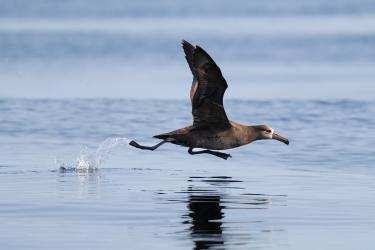
Scientists Develop Genetic Tools to Study Black-footed Albatross Bycatch

This provides a basis for better understanding the demographic impact of bycatch on seabird colonies and foundation for targeted management.
May 14, 2025 - News ,
A black-footed albatross takes flight over calm blue water.

New Study Sheds Light on Salmon Behavior in Trawl Net

Collaborative effort identifies ways to improve technology to help salmon escape from commercial pollock nets.
April 18, 2025 - Feature Story ,
An underwater image of an open trawl net with a salmon and pollock in the foreground swimming toward the camera. Image of salmon (left) and pollock (right) swimming forward from the codend when the trawl is near the surface and the rate of water flow has slowed down.

Is U.S. Wild-Caught Shrimp Sustainable? The Short Answer Is Yes

Learn the facts about wild-caught American shrimp, including what makes it a sustainable seafood choice.
October 29, 2024 - Feature Story ,
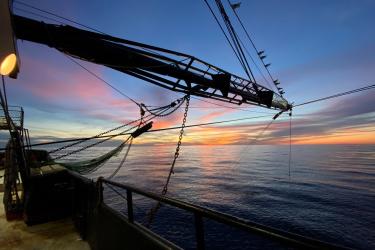
Shrimp trawl during sunset

2024 Bycatch Reduction Engineering Program Awards

NOAA Fisheries is recommending more than $2.6 million in funding for 13 projects under its 2024 Bycatch Reduction Engineering Program.
September 30, 2024 - Feature Story ,
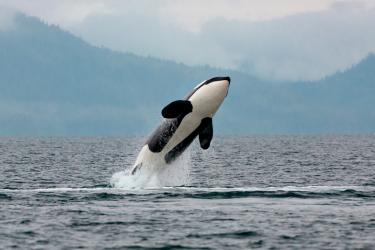
Orca jumping out of water. Jumping orca in Prince William Sound, Alaska. Credit: iStock