Refine Results
Region
News Category
Topic
Species Category

News

184 items match your filter criteria.

Shore-Based Observers Strengthen Catch Accounting in Alaska’s Pollock Fishery

Scientists explored the effectiveness of shore-based observers in place of at-sea observers in a high-volume trawl fishery. They also developed a structured approach to evaluate shoreside monitoring programs in fisheries that lack at-sea human observers.
January 23, 2026 - Feature Story ,
A fisheries observer in an orange coat and green overall bibs leans over a blue fishing tote with two salmon laid on the top. One is being measured on a measuring board. A shore-based fisheries observer collects data from a salmon caught in the pollock fishery at a fish processing plant in Alaska. Credit: NOAA Fisheries/North Pacific Observer Program

Snow Crab Collapse Linked to Energetic Limitations During a Marine Heatwave

New study provides critical insights into the Bering Sea snow crab population collapse in 2018–2019, offers hope for recovery, and provides a new tool for fisheries management.
December 05, 2025 - Feature Story ,
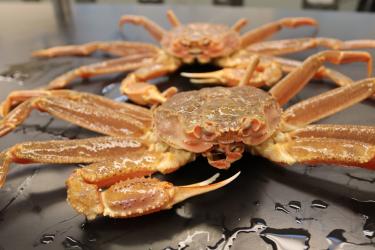
On the back deck of a fisheries survey vessel, two adult snow crabs on top of a blue plastic tote. Snow crabs sampled during the 2024 eastern Bering Sea bottom trawl survey. Credit: NOAA Fisheries / Erin Fedewa

Modernizing Fisheries Survey Science: Advancing NOAA’s Fisheries-Independent Data Collection

As marine ecosystems change and technology advances, modernizing survey tools allows NOAA to maintain critical survey time series and deliver the best available science to support sustainable fisheries management.
August 22, 2025 - Feature Story ,
A group of five people are surrounded by a large red fisheries trawl net. The net is hung avove them and hangs onto the floor and under their feet. Shawn Russell trains the other fisheries scientists about the net operations. Shawn Russell, AFSC Net Shed and Survey Support Team Supervisor, leading a training on bottom trawl survey gear in the net shed, a converted World War II era airplane hangar at the Alaska Fisheries Science Center's Seattle Campus. Credit: Emily Markowitz/NOAA Fisheries.

The Endangered Population of False Killer Whales in the Main Hawaiian Islands is Declining

A new analytical method accounting for animal movement improves population size estimates of endangered false killer whales in Hawaiʻi and reveals the population has been declining for more than a decade.
August 14, 2025 - Feature Story ,
From nose to dorsal fin, the body of a false killer whale surfaces above the water. Behold the rounded head, dark coloration, and torpedo-like body of the false killer whale. Credit: NOAA Fisheries/Marie Hill (Permit #25754)

From Water to Data: A Roadmap for Using eDNA in Stock Assessments

Scientists identify key challenges and solutions for integrating environmental DNA into fisheries stock assessments.
July 09, 2025 - Feature Story ,
A scientist filters water samples in the R/V Bell M. Shimada Chemistry Lab A scientist filters water samples in the R/V Bell M. Shimada Chemistry Lab. Credit: UW APL/Phil LaMothe.

Logging into Efficiency: Modernizing Atlantic Coastwide Permit and Vessel Logbooks

NOAA Fisheries is modernizing our Atlantic Coast logbook reporting systems for both commercial and for-hire fishermen to improve efficiency and lower costs.
July 02, 2025 - Feature Story ,
Bows of three fishing vessels tied together. Fishing boats in New England

Monk Seal and Sea Turtle Research and Recovery: A Year in Review

Fresh survey techniques, historic data retrieval, and rehabilitated new moms were just a few of the successes marked by the 2024 field camp season in the Papahānaumokuākea Marine National Monument.
May 05, 2025 - Feature Story ,
Pink and purple sunrise clouds over several field camps tents with many birds in the air. Caption: Field camp at sunrise on Tern Island, Lalo. Credit: NOAA Fisheries (Permit #PMNM-2024-001)

Long-Running Sea Scallop Survey Diversifies for the Future

Using more vessels and more sampling to ensure data keeps coming for a top U.S. fishery.
April 07, 2025 - Feature Story ,
The HabCam going over the stern of a research vessel with deckhands managing a deployment using cables. Deploying HabCam V4 from the NOAA Ship Henry B. Bigelow on the 2024 Integrated Sea Scallop and HabCam Research Survey. Credit: NOAA Fisheries/Dvora Hart

Scientists Use Uncrewed Surface Vehicle to Estimate Krill Abundance in Alaska

A commonly used machine-learning algorithm was key to help generate krill abundance estimates comparable to data collected by research vessels over many years.
February 20, 2025 - Feature Story ,
Pale krill against a black background. Krill (Thysanoessa inermis). Credit: NOAA Fisheries.