Refine Results
Region
News Category
Topic
Species Category

News

635 items match your filter criteria.

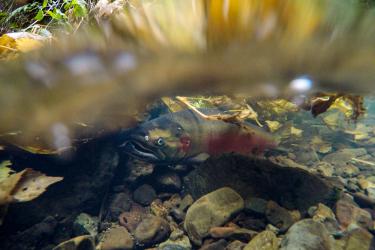
Record 30,000 Endangered Central California Coast Coho Salmon Return to Mendocino Coast Rivers

Back-to-back record spawning seasons suggest that reconnecting tributaries and restoring salmon habitat is supporting Central California Coast Coho population growth. NOAA has funded more than 100 restoration projects on the Mendocino Coast.
March 26, 2026 - Feature Story ,
A large green-ish fish with a red stripe and black spots swims in a shallow, rocky stream Adult CCC coho spawning at Neefus Gulch. Trout Unlimited removed a fish passage barrier at this location with NOAA funding in 2024. Credit: Christie Hemm Klok/Trout Unlimited

Marsh Madness

While players duel it out on the court, we’re keeping score of all the ways marsh habitat plays an important role in the protection and restoration work we do for communities, fish, and wildlife.
March 16, 2026 - Feature Story ,
Two people on stand up paddleboards in a wetland Stand-up paddle boarders explore marsh around Wrightsville Beach, North Carolina. Credit: Hank Carter.

Restoring the Indian River Lagoon’s Seagrass Meadows and Wetlands

NOAA support is driving large-scale seagrass and wetland restoration in Florida’s Indian River Lagoon, delivering benefits for fisheries, water quality, and coastal communities.
March 05, 2026 - Feature Story ,
A person holding a long pole stands on a boat in shallow water. In the water, dense beds of seagrass can be seen Recovering seagrass meadows in the Indian River Lagoon. Credit: Lorae Simpson/Indian River Lagoon Council

Restoration Innovation on the Indian River Lagoon: Spartan Reefs, Super Clams, and More

With funding from NOAA, our partners are tackling the challenges of restoring Florida’s Indian River Lagoon
March 04, 2026 - Feature Story ,
Two gloved hands hold a pile of very small clam shells. Below, thousands more of the shells are visible Juvenile “super clams” ready for dispersal in the Indian River Lagoon. Credit: Indian River Lagoon Council

Habitat Restoration in the Great Lakes: By the Numbers

NOAA’s habitat restoration work in the Great Lakes strengthens healthy fisheries and ecosystems, benefits local economies, and supports resilient communities.
March 02, 2026 - Feature Story ,
A large partially forested island in the middle of a river Aerial view of Belle Isle in the Detroit River. Credit: Friends of the Detroit River.

Investing in Indian River Lagoon Restoration Pays Dividends

NOAA-funded restoration projects in Florida’s Indian River Lagoon generate strong economic returns, supporting jobs, boosting fisheries, and delivering environmental benefits worth billions of dollars.
February 27, 2026 - Feature Story ,
A fish caught on a line leaps above the surface of the water at sunset Sport fishing and other outdoor recreation on the Indian River Lagoon help support the local economy. Credit: Indian River Lagoon Council

A System-Wide Effort to Restore Florida’s Indian River Lagoon

With $9.4 million in NOAA funding, the Indian River Lagoon Council and its partners are carrying out 15 projects across the estuary to restore seagrass, wetlands, shellfish populations, and shorelines.
February 26, 2026 - Feature Story ,
Piers line a bright blue water channel dotted with moored boats Florida’s Indian River Lagoon. Credit: Indian River Lagoon Council

Muskegon Lake Removed from List of Most Degraded Great Lakes Sites

Through a multi-year partnership with the Great Lakes Commission, NOAA has helped restore what was once one of the Great Lakes region’s most degraded areas.
February 04, 2026 - Feature Story ,
A road passes a creek through restored wetlands The Bear Creek project site, post-restoration. Credit: Muskegon Lake Watershed Partnership.

The Turf Trap: Why Florida’s Reefs are Stuck in a Recovery Rut

The “old rules” for recovering coral reefs might not work in places like Florida. A new study has identified a new culprit preventing recovery: long sediment-laden algal turfs.
February 03, 2026 - Feature Story ,
A colony of grooved brain coral (Diploria labyrinthiformis) outplanted by NOAA’s CoRAL Team growing on a reef in Miami, FL. Note the border of the colony, which is surrounded by long sediment-laden algal turf. A colony of grooved brain coral (Diploria labyrinthiformis) outplanted by NOAA’s CoRAL Team growing on a reef in Miami, FL. Note the border of the colony, which is surrounded by long sediment-laden algal turf. Credit: Dr. Mark Ladd/NOAA Fisheries SEFSC