Refine Results
Region
News Category
Topic
Species Category

News

181 items match your filter criteria.

50 Years of Innovation and Leadership: Celebrating the Magnuson-Stevens Act

NOAA Fisheries Assistant Administrator Eugenio Piñeiro Soler reflects on the legacy and the future impact of the Act.
April 13, 2026 - Leadership Message ,
U.S. Senators Ted Stevens (R-AK) and Warren Magnuson (D-WA) having a conversation in their neighboring senate seats, with state flags in the background. U.S. Senators Ted Stevens (R-AK) and Warren Magnuson (D-WA), 1973.

Genetics Shines New Light on Cod Populations and Distributions in Alaska

Researchers identify distinctive genetic stocks of Pacific cod in Alaska and use that information to build a cost-effective genetic tool to answer important ecological questions for the species.
April 03, 2026 - Feature Story ,
Researcher lean over a table and measure juvenile Pacific cod on white measure boards Scientists measure juvenile Pacific cod and extract tissues for genetic analysis. Credit: NOAA Fisheries/Johanna Vollenweider

Record 30,000 Endangered Central California Coast Coho Salmon Return to Mendocino Coast Rivers

Back-to-back record spawning seasons suggest that reconnecting tributaries and restoring salmon habitat is supporting Central California Coast Coho population growth. NOAA has funded more than 100 restoration projects on the Mendocino Coast.
March 26, 2026 - Feature Story ,
A large green-ish fish with a red stripe and black spots swims in a shallow, rocky stream Adult CCC coho spawning at Neefus Gulch. Trout Unlimited removed a fish passage barrier at this location with NOAA funding in 2024. Credit: Christie Hemm Klok/Trout Unlimited

Cod vs. Crab: It’s Not Just Cod Abundance—Size Influences Predation on Crab

A new study uses spatial models to precisely map how Pacific cod prey on commercially important snow and southern Tanner crabs in the eastern Bering Sea.
March 19, 2026 - Feature Story ,
Image of Pacific cod resting on the seafloor Pacific cod in Alaska waters. Credit: NOAA Fisheries.

Shore-Based Observers Strengthen Catch Accounting in Alaska’s Pollock Fishery

Scientists explored the effectiveness of shore-based observers in place of at-sea observers in a high-volume trawl fishery. They also developed a structured approach to evaluate shoreside monitoring programs in fisheries that lack at-sea human observers.
January 23, 2026 - Feature Story ,
A fisheries observer in an orange coat and green overall bibs leans over a blue fishing tote with two salmon laid on the top. One is being measured on a measuring board. A shore-based fisheries observer collects data from a salmon caught in the pollock fishery at a fish processing plant in Alaska. Credit: NOAA Fisheries/North Pacific Observer Program

Snow Crab Collapse Linked to Energetic Limitations During a Marine Heatwave

New study provides critical insights into the Bering Sea snow crab population collapse in 2018–2019, offers hope for recovery, and provides a new tool for fisheries management.
December 05, 2025 - Feature Story ,
On the back deck of a fisheries survey vessel, two adult snow crabs on top of a blue plastic tote. Snow crabs sampled during the 2024 eastern Bering Sea bottom trawl survey. Credit: NOAA Fisheries / Erin Fedewa

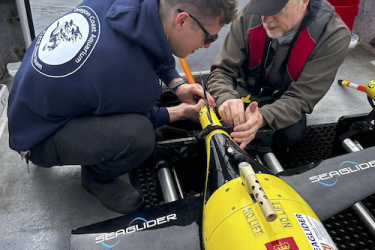
Modernizing Fisheries Survey Science: Advancing NOAA’s Fisheries-Independent Data Collection

As marine ecosystems change and technology advances, modernizing survey tools allows NOAA to maintain critical survey time series and deliver the best available science to support sustainable fisheries management.
August 22, 2025 - Feature Story ,
A group of five people are surrounded by a large red fisheries trawl net. The net is hung avove them and hangs onto the floor and under their feet. Shawn Russell trains the other fisheries scientists about the net operations. Shawn Russell, AFSC Net Shed and Survey Support Team Supervisor, leading a training on bottom trawl survey gear in the net shed, a converted World War II era airplane hangar at the Alaska Fisheries Science Center's Seattle Campus. Credit: Emily Markowitz/NOAA Fisheries.