Internet Explorer lacks support for the features of this website. For the best experience, please use a modern browser such as Chrome, Firefox, or Edge.
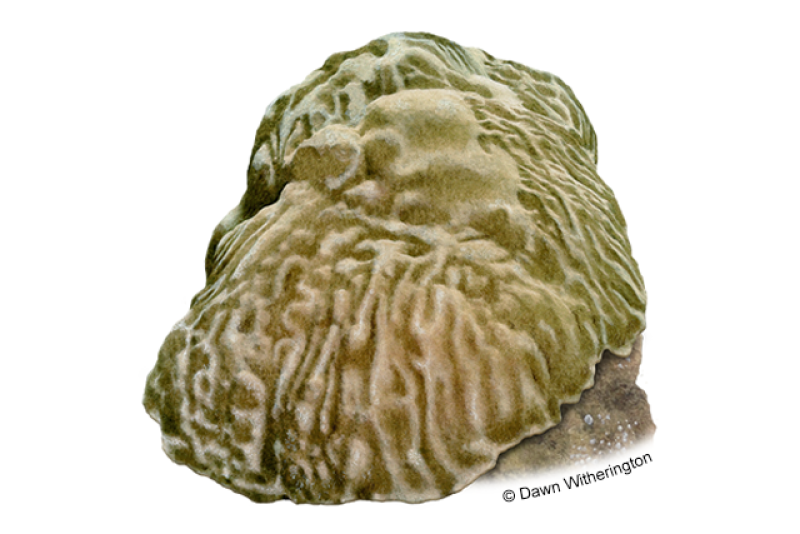
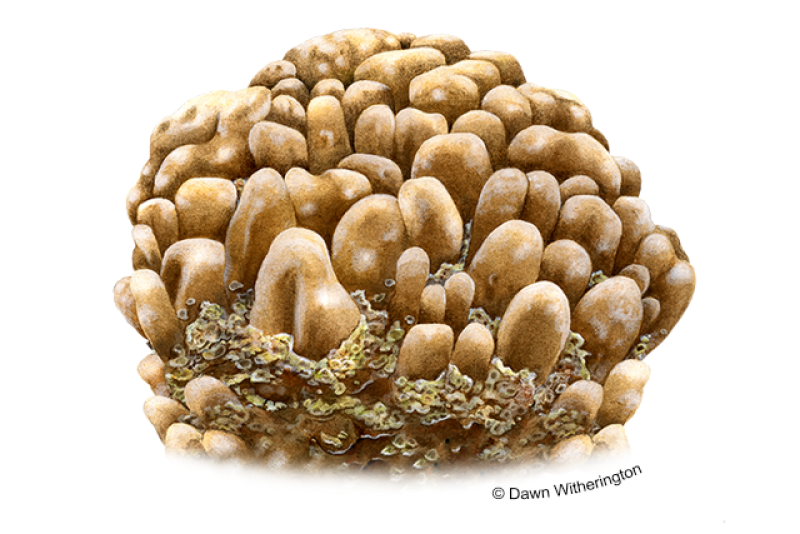
Mountainous star coral is native to the Caribbean Sea and the Gulf of Mexico. Its color is usually pale brown but may be deep brown with fluorescent green highlights. Mountainous star coral is listed as threatened under the Endangered Species Act.
Mountainous Star Coral
Orbicella faveolata
Protected Status
ESA Threatened
Throughout Its Range
CITES Appendix II
Throughout Its Range
SPAW Annex II
Throughout the Wider Caribbean Region
Quick Facts
Lifespan
Up to hundreds of years
Threats
Climate change (including ocean warming and ocean acidification),
Diseases,
Habitat degradation,
Land-based sources of pollution,
Unsustainable fishing
Region
Southeast
Mountainous star coral. Credit: NOAA Fisheries
About the Species
Mountainous star coral. Credit: NOAA Fisheries
Mountainous star coral, along with boulder star coral and lobed star coral, make up the star coral species complex. The species complex was considered a single species with growth forms ranging from columns, to massive boulders, to plates but was split into three separate species in the early 1990s. The three species were differentiated on the basis of growth form, depth range, ecology, and behavior.
The species complex was historically one of the primary builders of reef framework in the Caribbean. It was once dominant on Caribbean coral reefs, characterizing the so-called “buttress zone.” However, it began to dramatically decline in the 1990s and 2000s. The greatest threats to mountainous star coral are disease and ocean warming, which causes the corals to release the algae that live in their tissue and provide them food, usually causing death. Other threats to mountainous star coral are ocean acidification (decrease in water pH caused by increased carbon dioxide in the atmosphere) that makes it harder for them to build their skeleton, unsustainable fishing practices that deplete the herbivores (animals that feed on plants) that keep the reef clean, and land-based sources of pollution that impacts the clear, low nutrient waters in which they thrive.
Mountainous star coral is listed as threatened under the Endangered Species Act. NOAA Fisheries is committed to conserving and protecting mountainous star coral. Our scientists and partners use a variety of innovative techniques to study, learn more about, and protect this species.
Population Status
Mountainous star coral is common on Caribbean coral reefs but began to dramatically decline in the 1990s and 2000s, primarily from bleaching and disease. Over time there has been a shift from large colonies of this species to smaller colonies due to partial mortality resulting in shrinkage and disconnection of living tissue. Slow colony growth and extremely low successful reproduction limit the ability of mountainous star coral to recover.
Where They Live
Mountainous star coral can be found in the Caribbean Sea, Gulf of America, and southern Atlantic (southern Florida). The northern extent of the range in the Atlantic Ocean is Martin County, Florida. Mountainous star coral occupies most reef environments and has been reported from water depths ranging from 1 to 45 m, with the species complex reported to 90 m. It is a common, often dominant, component of Caribbean mesophotic (>40 m depth) reefs. NOAA Fisheries has designated six critical areas determined to provide critical recruitment habitat for mountainous star corals off the coast of Florida, the islands of Puerto Rico, the U.S. Virgin Islands, and Navassa, and in the Flower Garden Banks off the coast of Texas.
World map providing approximate representation of the Mountainous star coral's range
Lifespan & Reproduction
Mountainous star coral reaches reproductive maturity at about 10 cm in size. It is a hermaphroditic broadcast spawner, meaning colonies produce both eggs and sperm and release them into the water for fertilization and development. Mountainous star coral sexually reproduces once per year several nights following the full moon in late summer. Fertilized eggs develop into larvae that settle on hard surfaces and form new colonies. Growth rates are slow, generally about 1 cm per year. Colonies can live for hundreds of years.
Life cycle of corals. Credit: NOAA Fisheries
Scientific Classification
Kingdom
Animalia
Phylum
Cnidaria
Class
Anthozoa
Order
Scleractinia
Family
Merulinidae
Genus
Orbicella
Species
faveolata
Last updated by NOAA Fisheries on 09/11/2025
What We Do
Conservation & Management
We are committed to the protection and recovery of lobed star coral through implementation of various conservation, regulatory, and restoration measures. Our work includes:
Protecting habitat and designating critical habitat
Breeding mountainous star corals in nurseries and planting them into the wild
Gene banking mountainous star corals to preserve genetic diversity
Increasing mountainous star coral resilience to climate change
Rescuing injured mountainous star corals after ship groundings or major storm events
Use energy efficient lighting, bike to work, or practice other energy-saving actions to reduce greenhouse gas emissions. Climate change is one of the leading threats to coral reefs.
Anchor in sandy areas away from coral and obey aids-to-navigation/signage to make sure you do not accidentally injure corals that are just below the surface.
Reduce Chemical/Sunscreen Pollution
Choose sunscreen with zinc oxide or titanium dioxide over those containing oxybenzone, which is toxic to corals.
Mission Iconic Reefs field team member retrieves a transect tape after completing an outplant coral health assessment survey. Credit: Ben Edmonds/NOAA.
The Recovery Outline (PDF, 6 pages) is meant to serve as an interim guidance document to direct recovery efforts, including recovery planning, for pillar coral, rough cactus coral, lobed star coral, mountainous star coral, and boulder star coral.
Once a species is listed under the ESA, NOAA Fisheries evaluates and identifies whether any areas meet the definition of critical habitat. Those areas may be designated as critical habitat through a rule making process. The designation of an area as critical habitat does not create a closed area, marine protected area, refuge, wilderness reserve, preservation, or other conservation area; nor does the designation affect land ownership. Federal agencies that undertake, fund, or permit activities that may affect these designated critical habitat areas are required to consult with NOAA Fisheries to ensure that their actions do not adversely modify or destroy designated critical habitat.
We designated critical habitat for five threatened Caribbean coral species, including the mountainous star coral. Twenty-eight mostly overlapping specific occupied areas containing physical features essential to the conservation of these coral species were designated as critical habitat. These areas contain approximately 16,830 square kilometers (6,500 square miles) of marine habitat.
Conservation Efforts
Working to Enhance Populations
Severely reduced successful reproductive recruitment into the population is one of the major obstacles things impeding recovery of pillar corals. There are many factors that are contributing to this problem. NOAA Fisheries, with many partners, is are taking several steps to help, including:
Establishing a network of coral nurseries throughout the species’ range to conserve, grow, and asexually produce fragments and outplant them to the reef.
Researching and implementing sexual reproduction techniques such as cryopreservation (preserving through a cooling process) of sperm and collection and fertilization of eggs and sperm for short-term rearing in the lab and outplanting to the reef.
Responding to Physical Impacts
Ship grounding and other physical impacts can break corals. If the broken fragments are stabilized quickly after being broken, the corals can survive and continue to grow. NOAA Fisheries supports a program to respond to these events in Puerto Rico and the U.S. Virgin Islands where tens of thousands of corals have been rescued.
Conserving Coral Reefs
NOAA Fisheries is part of the NOAA Coral Reef Conservation Program which brings together a team of various expertise from across NOAA to understand and conserve coral reef ecosystems. The NOAA Coral Reef Conservation Program focuses on implementing projects to address the impacts from the top three recognized global threats to coral reefs: climate change (including ocean acidification), land-based sources of pollution, and unsustainable fishing practices.
We, NOAA Fisheries, designate critical habitat for five threatened Caribbean coral species, Orbicella annularis, O. faveolata, O. franksi, Dendrogyra cylindrus, and Mycetophyllia ferox, pursuant to section 4 of the Endangered Species Act (ESA). Twenty…
We, NOAA Fisheries, are publishing this final rule to implement our final determination to list the following 20 species as threatened: five in the Caribbean (Dendrogyra cylindrus, Orbicella annularis, Orbicella faveolata, Orbicella franksi, and…