Refine Results
Region
News Category
Topic
Species Category

News

46 items match your filter criteria.

Green Crab Detected in Alaska for the First Time

NOAA Fisheries and partners confirm presence of invasive green crabs on Annette Islands Reserve.
August 24, 2022 - Feature Story ,
The carapace of an invasive green crab, and a live green crab. Credit: Linda Shaw/NOAA Fisheries The carapace of an invasive green crab, and a live green crab. Credit: Linda Shaw/NOAA Fisheries

National Fish Habitat Partnership Projects to Engage Recreational Fishing Partners and Restore Habitat

Nearly $150,000 will support habitat restoration and angler engagement in Hawai’i, South Carolina, and Alaska.
June 07, 2022 - Feature Story ,
An adult shows a tub of coral fragments to a group of young children Kuleana Coral Reefs staff teaches future anglers about coral as critical fish habitat in Hawaiʻi. Credit: Kuleana Coral Reefs/Blake Nowack.

Cancer-Fighting Green Sponge Brings More Than Just Good Luck!

The unique green color of the Latrunculina austini sponge gives it St. Patrick’s Day spirit all year long. Instead of a pot of gold, this sponge’s value lies in its molecular chemical composition—it targets and kills pancreatic and ovarian tumor cells.
March 17, 2022 - Feature Story ,
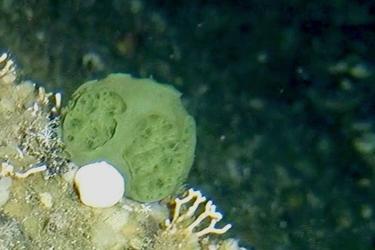
A Latrunculia austini sponge is measured by red laser dots. During dive expeditions, submersibles use various cameras and sensors to survey the seafloor and water column. In this image, red lasers beamed from a submersible are being used to measure the size of a Latrunculia austini sponge. Credit: Bob Stone/NOAA Fisheries.

Student Interns Take a Virtual Dive into the World of Deep-Sea Corals and Sponges

From coast to coast, college seniors and recent graduates contribute to NOAA’s Deep Sea Coral Research and Technology Program research goals through unique projects.
October 05, 2021 - Feature Story ,
A green sponge on the sea floor The green sponge Latrunculia austini was discovered in 2005 by NOAA Fisheries coral biologist Bob Stone. Credit: NOAA Fisheries.

National Fish Habitat Partnership’s 2021 Waters to Watch Projects Feature Coastal Habitats

A highlight of five of the National Fish Habitat Partnership's 2021 Waters to Watch projects that take place in coastal, estuarine, and marine habitats where NOAA works.
October 05, 2021 - Feature Story ,
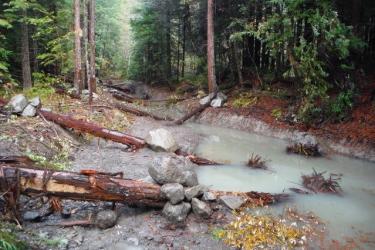
A creek with large pieces of wood place in it flows through a forest Lawrence Creek in the Eel River watershed in California. Credit: Trout Unlimited.

Discovering Deep-Sea Sponges in Alaska

Hundreds of species have yet to be described in the ecosystems that support Alaska’s valuable commercial fisheries.
September 02, 2021 - Feature Story ,
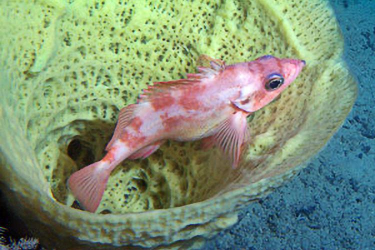
Underwater photo of a pink fish hiding inside a conical yellow sponge. A pregnant sharpchin rockfish shelters within a sponge on the seafloor off Alaska. Credit: NOAA Fisheries.

Multi-Year Effort To Observe Seafloor Habitats And Learn More About Deep-sea Corals And Sponges In Alaska

The four-year Alaska Deep-Sea Coral and Sponge Initiative is part of an effort to improve our understanding of deep-sea coral communities and aid resource managers in developing and evaluating management options for these valuable habitats.
August 09, 2021 - Feature Story ,
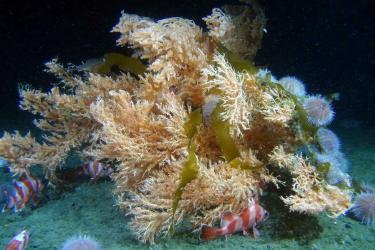
Underwater photo of orange and white striped rockfish and sea urchins congregating around a large red tree coral on the seafloor. Rockfish and sea urchins congregate around a large red tree coral (Primnoa pacifica) in the Gulf of Alaska. Photo credit: NOAA Fisheries.

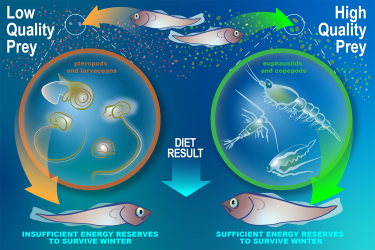
Low-Fat Diet Possible Culprit in Poor Survival of Young Pollock Born 2013

A case study of Alaska pollock born in 2013 provides valuable insight on how diet and habitat influence survival of this commercially valuable fish.
July 20, 2021 - Feature Story ,
Infographic showing that pollock that eat low quality prey build insufficient energy reserves to survive winter, while pollock who consume high quality prey do build sufficient energy reserves for winter.