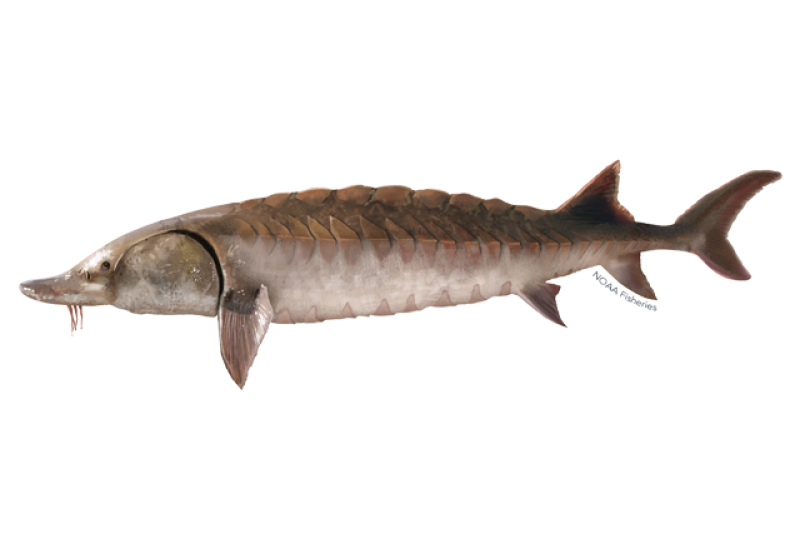
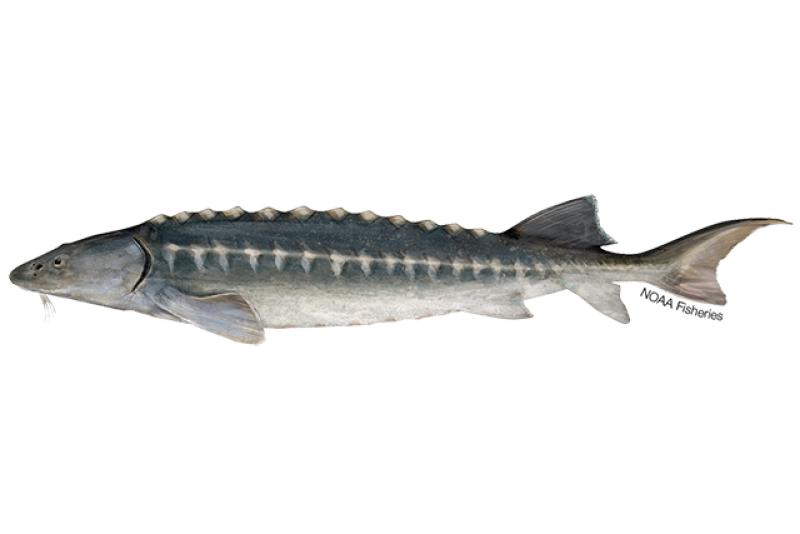
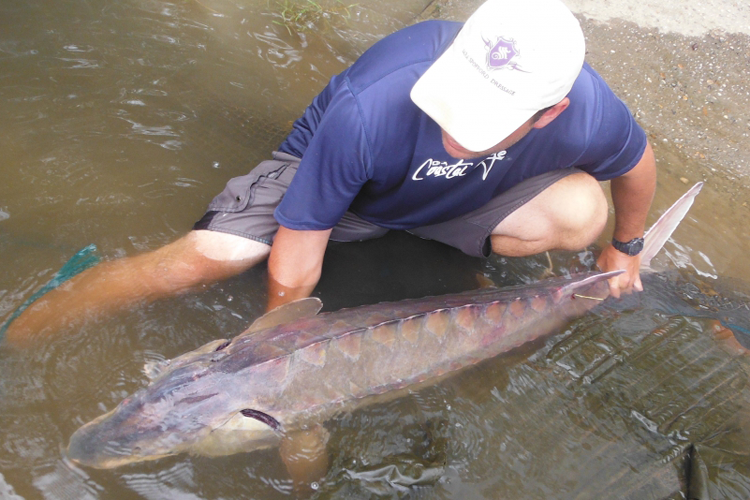
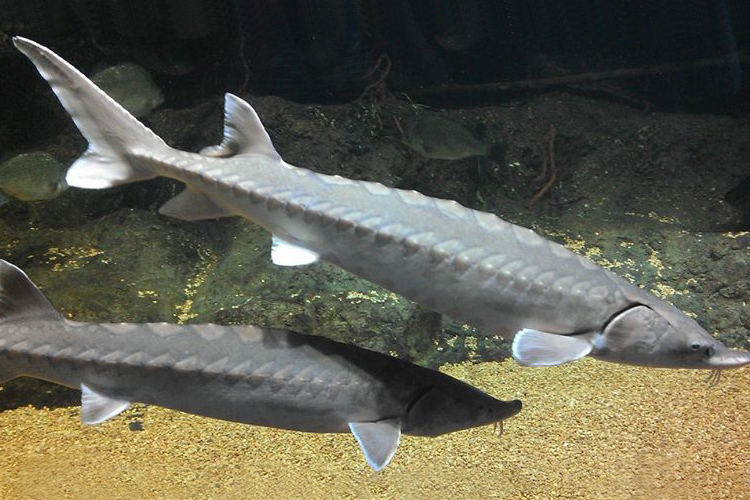
 Atlantic sturgeon swimming. Credit: NOAA Fisheries
Atlantic sturgeon swimming. Credit: NOAA Fisheries
About the Species
Atlantic sturgeon swimming. Credit: NOAA Fisheries
Atlantic sturgeon swimming. Credit: NOAA Fisheries
Atlantic sturgeon live in rivers and coastal waters from Canada to Florida. Hatched in the freshwater of rivers, Atlantic sturgeon head out to sea as sub-adults, and return to their birthplace to spawn, or lay eggs, when they reach adulthood.
The Atlantic sturgeon has five rows of bony plates known as scutes that run along its body and a snout with four slender, soft tissue projections called barbels in front of its mouth. In addition, the tail is like a shark’s where one side, or lobe, is larger than the other. All of these features give the fish its unique look.
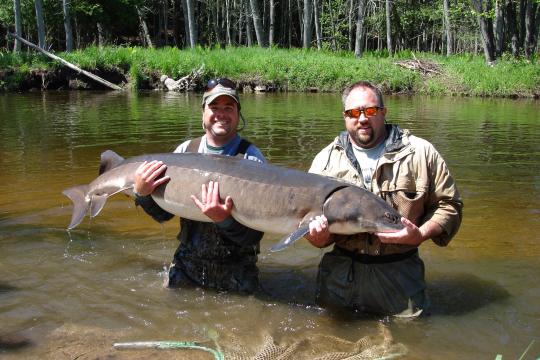
Atlantic sturgeon are slow-growing and late-maturing, and have been recorded to reach up to 14 feet in length and up to 60 years of age.
Indigenous tribes have harvested Atlantic and shortnose sturgeon for their meat and eggs (roe) beginning some 4,000 years ago, and sturgeon are credited as the primary food source that saved the Jamestown settlers in 1607. Atlantic sturgeon were once found in great abundance, but their populations have declined greatly due to overfishing and habitat loss. Atlantic sturgeon were prized for their eggs, which were valued as high-quality caviar. During the late 1800s, people flocked to the eastern United States in search of caviar riches from the sturgeon fishery, known as the “Black Gold Rush.” By the beginning of the 1900s, sturgeon populations had declined drastically. Close to 7 million pounds of sturgeon were reportedly caught in 1887, but by 1905, the catch declined to only 20,000 pounds. By 1989, only 400 pounds of sturgeon were recorded. However, historical landings records generally failed to differentiate between Atlantic sturgeon and the smaller shortnose sturgeon, making it difficult to determine historical trends in abundance for populations of either species.
Today, all five U.S. Atlantic sturgeon distinct population segments are listed as endangered or threatened under the Endangered Species Act. The populations in Canada are not protected species under the U.S. Endangered Species Act. The primary threats currently facing Atlantic sturgeon are entanglement in fishing gear, habitat degradation, habitat impediments, such as dams and other barriers, and vessel strikes.
NOAA Fisheries and our partners are dedicated to conserving and rebuilding Atlantic sturgeon populations along the East Coast. We use a variety of innovative techniques to study, protect, and recover these endangered fish. Working closely with our partners, we develop regulations and management plans that preserve and restore sturgeon habitat, monitor bycatch, and promote population recovery.
Population Status
The historical and current range of Atlantic sturgeon includes major estuaries and river systems from Canada to Florida. While still found throughout their historical range, Atlantic sturgeon spawning is known to occur in only 22 of 38 historical spawning rivers. Adult and sub- adults Atlantic sturgeon also range widely throughout the marine environment.
Learn more about the population estimates for Atlantic sturgeon
Atlantic sturgeon were listed under the ESA in 2012 as five distinct population segments. A distinct population segment is the smallest division of a species permitted to be protected under the ESA. Atlantic sturgeon that hatch out in Gulf of Maine rivers are listed as threatened, and those that hatch out in other U.S. rivers are listed as endangered. Atlantic sturgeon that hatch out in Canadian rivers are not listed as protected species under the ESA.
Appearance
Atlantic sturgeon can grow to approximately 16 feet long and can weigh up to 800 pounds. They are bluish-black or olive brown dorsally (on their back) with paler sides and a white belly. They have five major rows of dermal "scutes,” or bony plates, along the length of their body.
Atlantic sturgeon are similar in appearance to shortnose sturgeon but can be distinguished by their larger size, smaller mouth, different snout shape, and tail scute pattern.
Behavior and Diet
Spawning runs of Atlantic sturgeon are still not completely understood. In rivers from Georgia to the Chesapeake Bay, scientists have confirmed that adult sturgeon spawn during the late summer and fall. In rivers from Delaware to Canada, adults spawn in the spring and early summer. There is information to suggest that some rivers may support both a fall and a separate spring spawning population.
After spawning, males in northern rivers may remain in the river or lower estuary until the fall; females typically exit the rivers within 4 to 6 weeks after spawning. In southern rivers, males usually enter the river in late summer when temperatures can be as high as 90°F, spawn as river temperatures approach 75 to 70°F, with females leaving immediately after spawning and males leaving as temperatures drop below 65°F.
Upon hatching, larvae hide along the bottom and drift downstream until they reach brackish waters where they may reside for 1 to 5 years before moving into nearshore coastal waters. Juvenile fish can leave their natal rivers as early as 1 year of age, so sometimes juvenile aggregations within a river may be composed of two or more different natal populations of fish. Tagging data indicate that these immature Atlantic sturgeon travel widely once they leave their birth rivers.
Atlantic sturgeon are bottom feeders. They typically consume invertebrates, such as crustaceans, worms, and mollusks, and bottom-dwelling fish, such as sand lance.
Where They Live
Historically, Atlantic sturgeon ranged along the Canadian and U.S. Atlantic Coast from Labrador to Florida. Due to overfishing, the abundance of natal populations is much less than historical levels, but breeding populations still exist in at least 22 U.S. rivers from Maine to Georgia and in several more in Canada. Atlantic sturgeon are anadromous fish—they are born in freshwater and then migrate to the sea and back again to freshwater to spawn. Most juveniles remain in their river of birth (natal river) for at least several months before migrating out to the ocean. Tagging data indicate that these immature Atlantic sturgeon travel widely up and down the East Coast and as far as Iceland when they are at sea.
Lifespan & Reproduction
Atlantic sturgeon lifespan is correlated with how far north or south they live. They live up to 60 years in Canada but likely only 25 to 30 years in the Southeast. Southern populations typically grow faster and reach sexual maturity earlier than northern populations. For example, Atlantic sturgeon mature in South Carolina rivers at 5 to 19 years of age, in the Hudson River at 11 to 21 years, and in the Saint Lawrence River at 22 to 34 years.
Atlantic sturgeon spawning intervals range from 1 to 5 years for males and 2 to 5 years for females, with males returning almost every year and females usually returning every other year or every third year. Female egg production correlates with age and body size, and ranges from 400,000 to 2 million eggs. Atlantic sturgeon take approximately 3 to 10 times longer than other bony fish species to reach 50 percent of their maximum lifetime egg production. In the Hudson River, females reach 50 percent of their maximum lifetime egg production at approximately 29 years. Fish from more southern rivers reach this production metric at an earlier age and fish from Maine and Canada reach it at a later age.
Threats
The most significant threats to Atlantic sturgeon are unintended catch (bycatch) in some commercial fisheries, dams that block access to spawning areas, poor water quality (which harms development of sturgeon offspring), dredging of spawning areas, water withdrawals from rivers, and vessel strikes.
Fisheries Interactions and Bycatch
Bycatch of Atlantic sturgeon occurs primarily in gillnet and trawl fisheries. The prevalence and likelihood of bycatch varies by fishing season. The fishing season also impacts the likelihood of sturgeon survival, which is more likely in cooler waters. Fisheries conducted within rivers and estuaries may intercept Atlantic sturgeon of any life stage, while fisheries conducted in the nearshore and ocean waters are more likely to capture juveniles and adults.
Learn more about fishing gear and risks to protected species
Habitat Degradation
Atlantic sturgeon habitat can be disrupted, degraded, or lost because of various human activities, such as dredging, damming, and withdrawing water. Groundwater pumping and dredging has resulted in saltwater intrusion, and industrialization and development has impacted sediments and water quality through the introduction of nutrients and other contaminants. Sturgeon need hard bottom substrates in freshwater reaches for successful spawning, so any activity that affects those features directly (e.g., dredging) or indirectly (e.g., sedimentation or saltwater intrusion) would affect Atlantic sturgeon habitat. All life stages of Atlantic sturgeon also require sufficient water quantities and qualities, which are often impacted by the activities above.
Habitat Impediments
Locks and dams on the Cape Fear River, North Carolina; the Santee-Cooper rivers, South Carolina; Savannah River, South Carolina/Georgia impede access to upstream spawning habitat. Recent dam removal projects on the Penobscot River, Maine and Rappahannock River, Virginia, have increased accessibility to upstream habitats.
Vessel Strikes
Atlantic sturgeon can be struck by boats or by the blades of boats’ propellers. They are struck and killed by large commercial vessels as well as smaller vessels such as recreational vessels. The risk of injury and mortality can be high in areas with high ship traffic, including the Hudson, Delaware, and James rivers. Information is emerging that suggests vessel strikes are also a threat to Atlantic sturgeon in the Savannah, Cooper, and Cape Fear rivers. We do not know how many sturgeon are struck by vessels and survive their injuries.
Learn more about how to report an injured or dead sturgeon
Scientific Classification
| Animalia |
Chordata |
Actinopterygii |
Acipenseriformes |
Acipenseridae |
Acipenser |
oxyrinchus |
Last updated by NOAA Fisheries on 05/22/2025